Sage Lorenz · 5 September 2026
Cedar Tree Adaptations in Portside Habitats and Their Ecological Implications
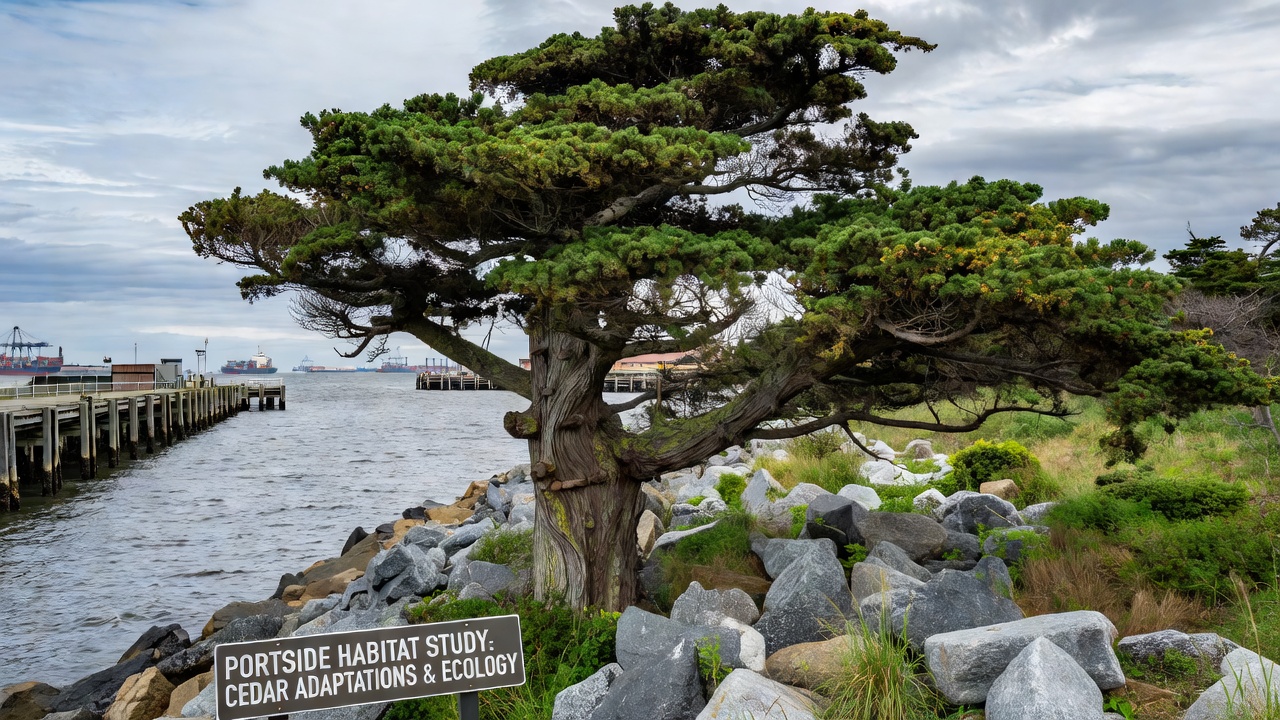
Cedar trees establish themselves in portside habitats through specialized traits that handle constant salt spray, strong winds, and unstable soils, and researchers track these features across coastal zones where shipping activity reshapes shorelines. These trees often develop thick bark that resists salt accumulation while their foliage sheds excess minerals during storms, allowing sustained photosynthesis even when tides push saline water inland.
Structural and Physiological Adaptations
Root systems of cedar species in these areas reach deep into compacted sediments to secure against tidal surges and vessel wakes, and studies from Natural Resources Canada show that lateral roots spread widely to capture freshwater lenses trapped above denser saltwater layers. Foliage tends to form dense, overlapping scales that reduce transpiration rates during dry spells between rains, whereas thicker cuticles on needles limit ion uptake when sea mist settles overnight. Observers note that certain populations produce resin canals that seal wounds from wind abrasion, and this response becomes more pronounced in trees near active docks where mechanical damage occurs frequently.
Genetic variations within local cedar stands further support survival because individuals with higher salt-exclusion capacity at the root level pass those traits to offspring, and data collected over multiple growing seasons reveal measurable differences in leaf sodium content between port-adjacent trees and inland counterparts. In September 2026 a multi-year monitoring program coordinated by the Canadian Forest Service plans to release updated maps of these genetic clusters along major shipping corridors.
Interactions with Portside Environmental Conditions
Portside soils often contain elevated heavy metals from runoff and fuel spills, yet cedar roots bind certain contaminants in bark and leaf litter, reducing their mobility into adjacent waters. This binding occurs alongside natural processes that stabilize shifting sands and gravels, and measurements from Environment and Climate Change Canada indicate lower erosion rates on vegetated port margins compared with cleared stretches. Wildlife such as shorebirds and small mammals use the dense lower branches for cover, creating microhabitats that support invertebrate communities adapted to brackish conditions.
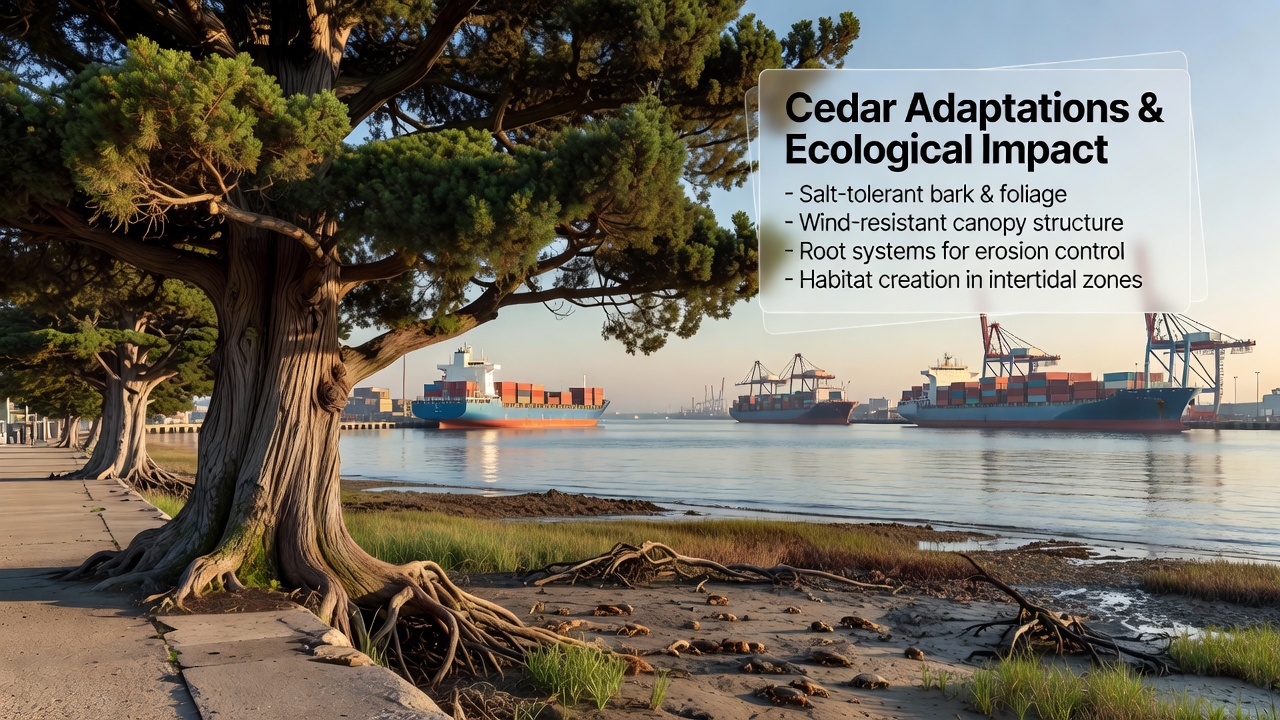
Seasonal leaf drop adds organic matter that buffers pH swings caused by industrial discharge, and researchers at the University of British Columbia have documented corresponding increases in microbial diversity within the litter layer. These changes unfold gradually because cedar growth rates remain moderate even under favorable moisture, allowing steady accumulation rather than sudden pulses of material.
Broader Ecological Implications
Established cedar stands alter light penetration to the forest floor, which in turn influences understory plant composition and favors shade-tolerant species that further bind the soil. Carbon storage accumulates in both living biomass and woody debris, and figures released by the U.S. Forest Service indicate that mature coastal cedars sequester measurable amounts per hectare despite exposure stresses. At the same time, these trees compete with faster-growing invasives for space and nutrients, and long-term surveys show they maintain dominance only where disturbance from port expansion stays limited.
Connectivity between portside cedar patches and nearby wetlands supports migratory species that rely on continuous canopy cover during stopovers, and tracking data from regional wildlife agencies confirm higher bird diversity along vegetated versus industrialized shorelines. Nutrient cycling within these stands recycles nitrogen and phosphorus captured from atmospheric deposition, reducing export into harbor waters where eutrophication risks remain a concern.
Conclusion
Cedar tree adaptations in portside habitats demonstrate how specific structural and physiological traits enable persistence amid dynamic coastal pressures, and the resulting ecological effects extend from soil stabilization and contaminant retention to support for local biodiversity and carbon storage. Continued documentation of these patterns, including work scheduled through September 2026, supplies baseline information for habitat management near active shipping facilities. Such records help clarify how cedar presence shapes ecosystem processes across regions where port development and natural shoreline functions intersect.